
If you are considering color analysis, you have probably already encountered several systems: 4 seasons, 12 seasons, 16 seasons, and perhaps even more.
So, does the system actually matter?
Yes. But before we talk about the differences, there is something important to understand: 12-season and 16-season color analysis are built on the same fundamental methodology.
Both systems analyze your natural coloring through characteristics such as undertone, depth, brightness, and softness. Both work with four home seasons: Spring, Summer, Autumn, and Winter. Both use subseasons and flows to identify where someone’s coloring sits within and between those larger seasonal families.
The main difference lies in how precisely that color spectrum is divided.
The 16-season system separates four color directions that remain incorporated into the broader home seasons in the 12-season system. It also approaches neutral coloring differently, allowing certain palettes to be fundamentally neutral rather than predominantly warm or cool.
So, choosing between 12-season and 16-season color analysis is less about choosing between two completely different philosophies and more about deciding how much refinement you want within the seasonal spectrum.
And this is where those additional seasons start to matter.
Before we compare the systems further, there is one terminology difference worth knowing.
Some comparable seasons have different names:
12-season Soft Summer → 16-season Muted Summer
12-season Soft Autumn → 16-season Muted Autumn
12-season Dark Winter → 16-season Deep Winter
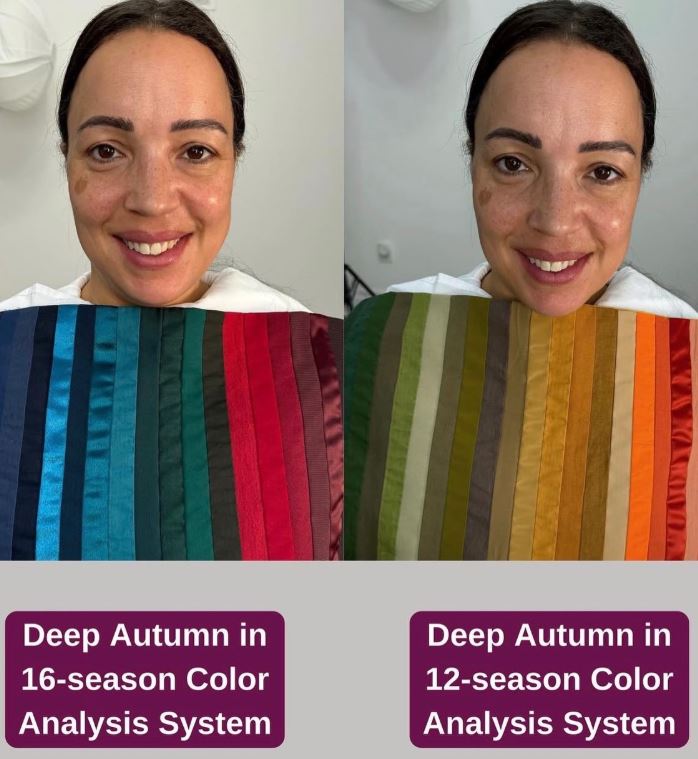
12-season Dark Autumn → 16-season Deep Autumn
While these seasons occupy comparable positions within their respective systems, the palettes themselves are not necessarily identical.
A 12-season Soft Autumn, for example, should not automatically be treated as identical to a 16-season Muted Autumn simply because they occupy a similar position within the Autumn family.
The same applies to Dark Autumn versus Deep Autumn and Dark Winter versus Deep Winter.
This becomes particularly important when we get to the second major difference between the systems: neutral coloring.
The difference between 12-season and 16-season color analysis goes much further than simply adding four more palettes.
In the Agile Styling 16-season methodology, those four additional seasons are:
Warm Spring
Warm Autumn
Cool Summer
Cool Winter
In the 12-season system, these color ranges are incorporated into their corresponding True home seasons. In the 16-season system, we separate them because people within those broader seasonal families can have noticeably different natural coloring and require different levels of depth, brightness, and softness.
This is where the additional precision becomes useful.
Warm Spring is a flow between True Spring and True Autumn, with Spring as its home season.
Both seasons are fully warm, but Warm Spring has an Autumn influence. Its palette becomes slightly darker and softer than True Spring.
You can often see this difference in the person as well.
True Springs tend to have lighter, clearer overall coloring. Warm Springs can carry more natural depth. Brown eyes, including deeper brown eyes, and brown hair can absolutely appear in this season while the overall coloring still belongs to Spring.
This is one reason a broader Spring palette can cover a surprisingly large spectrum. The lighter, clearer colors that support a True Spring and the slightly deeper, softer colors required by a Warm Spring represent two different expressions of Spring coloring.
The 16-season system separates them.
Warm Autumn sits on the other side of that same flow.
It falls between True Autumn and True Spring, with Autumn as its home season.
Warm Autumn retains Autumn’s earthy influence, but Spring introduces more light and brightness. The colors therefore become lighter and brighter than those of True Autumn.
The person may reflect this visually as well. Compared with the deeper, more grounded appearance we often see in True Autumn, Warm Autumn can appear lighter and more luminous. Hair may be lighter brown, copper, or naturally red, while the overall coloring still carries unmistakable Autumn warmth.
This distinction allows us to preserve Autumn’s character without expecting every Autumn to carry the same degree of depth and softness.
Cool Summer is a flow between True Summer and True Winter, with Summer as its home season.
Both are fully cool, but Winter’s influence gives Cool Summer greater depth and brightness.
True Summer coloring tends to appear softer and more diffused. Cool Summer can look more striking, with greater natural contrast and brighter features, while still retaining the softness that connects it to its Summer home season.
This is why I sometimes describe Cool Summer as True Summer on steroids. 🤌🏻
It is still unmistakably Summer, but it can carry stronger color, greater depth, and more contrast than True Summer.
Cool Winter completes that flow from the Winter side.
It sits between True Winter and True Summer, with Winter as its home season.
True Winter can carry tremendous depth, brightness, and contrast. Cool Winter receives Summer’s influence, so the palette becomes slightly lighter and softer.
That difference can appear in natural coloring too.
A Cool Winter may still have a bright, distinctly Winter appearance, but with less extreme contrast. You may see lighter or softer hair that carries more of a Summer quality, for example, while the face still requires considerably more clarity and intensity than a Summer palette could provide.
Cool Winter therefore should not simply be treated as a less dramatic styling version of True Winter. The difference begins with the person’s natural coloring, and the palette follows it.
Two people can share the same home season while requiring noticeably different expressions of it.
One Spring may need more light and clarity. Another may naturally carry greater depth and softness.
One Summer may look beautifully harmonious in gentle, softened colors. Another may need considerably more brightness and contrast before her features truly come alive.
The additional four seasons give those differences somewhere to belong.
And this brings us to the second major distinction between the systems, which is equally important.
Human coloring does not divide perfectly into warm and cool.
Some people have a distinctly warm undertone. Others are clearly cool. But there are also people whose coloring sits beautifully in the middle.
Neutral undertones exist, and they need neutral colors.
This is an important part of the 16-season methodology we use at Agile Styling.
Eight seasons have palettes that are fundamentally neutral, with a subtle influence from their home season:
Muted Summer and Muted Autumn
Bright Spring and Bright Winter
Light Spring and Light Summer
Deep Autumn and Deep Winter
Their home season still matters.
A Deep Autumn and a Deep Winter are not interchangeable simply because both are neutral. Autumn influences one, while Winter influences the other.
The important distinction is that the palette itself is neutral, with a slight lean determined by the home season.
For someone with naturally neutral coloring, this can make an enormous difference.
I would not reduce this conversation to one system being good and another being bad.
The 12-season system can work beautifully for many people.
The advantage of the 16-season color analysis system is greater refinement.
The four additional flow seasons allow us to distinguish between people who share the same home season but require different levels of depth, brightness, and softness.
The neutral palettes also allow us to work more specifically with people whose coloring does not sit predominantly on either the warm or cool side.
For someone who fits comfortably within a broader 12-season palette, the additional distinction may not feel dramatic.
For someone whose natural coloring falls into one of these more nuanced ranges, it can make an enormous difference.
That is why the color analysis system you choose is worth considering before you book your analysis.
At Agile Styling, I do not begin an analysis by trying to make a person fit a predetermined palette.
I look at what actually happens to the face during professional draping.
How much depth can you carry?
How much brightness?
How much softness?
What happens as temperature changes?
What level of contrast creates the most harmonious relationship between your features and your colors?
The palette follows the person.
That principle sits at the heart of the way I approach the 16-season system.
Knowing whether you are a Spring, Summer, Autumn, or Winter gives you a direction.
Understanding which version of that season truly reflects your natural coloring gives you a palette you can confidently use across your wardrobe, makeup, hair, and personal style.
If you are considering color analysis and want to discover your colors through the 16-season color analysis system, explore Agile Styling’s professional color analysis services and begin with a palette selected specifically for you.
I hope you enjoyed this blog. If you need your colors to be done, you know where to find me.
I would love to do your colors!
Love,
Julia