
AI Color Analysis vs. Professional Color Analysis: How Accurate Is AI?
AI color analysis is everywhere right now.
Apps, websites, quizzes, photo analyzers. Upload a selfie, wait a few seconds, and suddenly you are a Soft Summer, Warm Autumn, or Bright Winter.
Before color analysis became mainstream, very few technology companies cared about seasonal color analysis. Then color analysis became a major trend, and suddenly AI color analysis tools started appearing everywhere.
For me, this subject is especially interesting because before becoming a professional color analyst and stylist, I spent almost 20 years working in IT, including technology development and IT project management.
So I am very comfortable with technology. I understand development. I understand algorithms. And I understand why AI personal color analysis sounds so appealing.
Upload a photo. Get your season. Done.
But is AI color analysis actually accurate enough to trust with your wardrobe, makeup, hair, and shopping?
Right now, I would not.
And here is why.
How Does AI Color Analysis Work?
Different AI color analysis apps may use different technologies and different algorithms.
But fundamentally, they all have to start with the same thing:
the digital color information captured in your photograph.
A digital image represents color numerically, commonly through RGB values.
Some systems may work directly with those RGB values. Others may convert them into another color space, such as LAB, or process the information through more complex computer vision or AI models.
But the starting point is still the photographed color data.
The system may sample or interpret areas such as:
It then compares or classifies that information against the color characteristics associated with different seasonal palettes.
So imagine that your actual eyes are gray-blue.
In the photograph, because of lighting, camera processing, reflection, or white balance, they appear warmer and brighter.
AI does not see your real-life gray-blue eyes.
It sees the numerical color information captured in that photograph.
If those captured values fall closer to a warmer blue range, that information becomes part of the classification.
The same thing happens with skin.
If your skin appears warmer in the photograph because you are tanned, wearing foundation, standing in warm light, or because your phone changed the color balance, the system is analyzing that photographed version of your skin.
And this matters enormously in seasonal color analysis because we are working with very small differences in undertone, depth, intensity, and contrast.
The Biggest Limitation of AI Color Analysis Is Interpretation
The photograph itself is only the input.
The much bigger issue is how that information is interpreted.
This is where I see the biggest difference between AI color analysis and professional color analysis.
AI receives color information and processes it according to its model, algorithm, and classification system.
A professional color analyst is asking a much more complicated question:
What is this color actually doing to this person?
That is very different.
Let me give you a simple example.
You can have someone whose visible skin looks warm.
AI may detect those warm color values and move that person toward Autumn.
But as a professional analyst, I may immediately see that something does not make sense.
Maybe she just came back from vacation.
Maybe she has a temporary tan.
Maybe her foundation is too yellow.
Maybe the photograph itself is warm.
Then I look at what actually happens when I compare her against different color directions.
That is interpretation.
AI has data.
A professional analyst has data plus context, comparison, experience, and visual judgment.
Why Photo Quality Still Matters
Photo quality absolutely matters.
But I do not consider it the central problem.
The problem begins when inaccurate photographed color is interpreted as accurate information.
Lighting changes color.
Automatic white balance changes color.
Camera processing changes color.
Makeup changes visible skin color.
A tan changes visible skin color.
Dyed hair changes visible hair color.
So if an AI system samples a photograph in which your natural coloring has already shifted, it is beginning its analysis with shifted information.
And if that information is then matched to seasonal parameters, the result can move in the wrong direction very quickly.
The same limitation applies to AI seasonal color analysis in general: the system still has to interpret digital color information captured from an image.
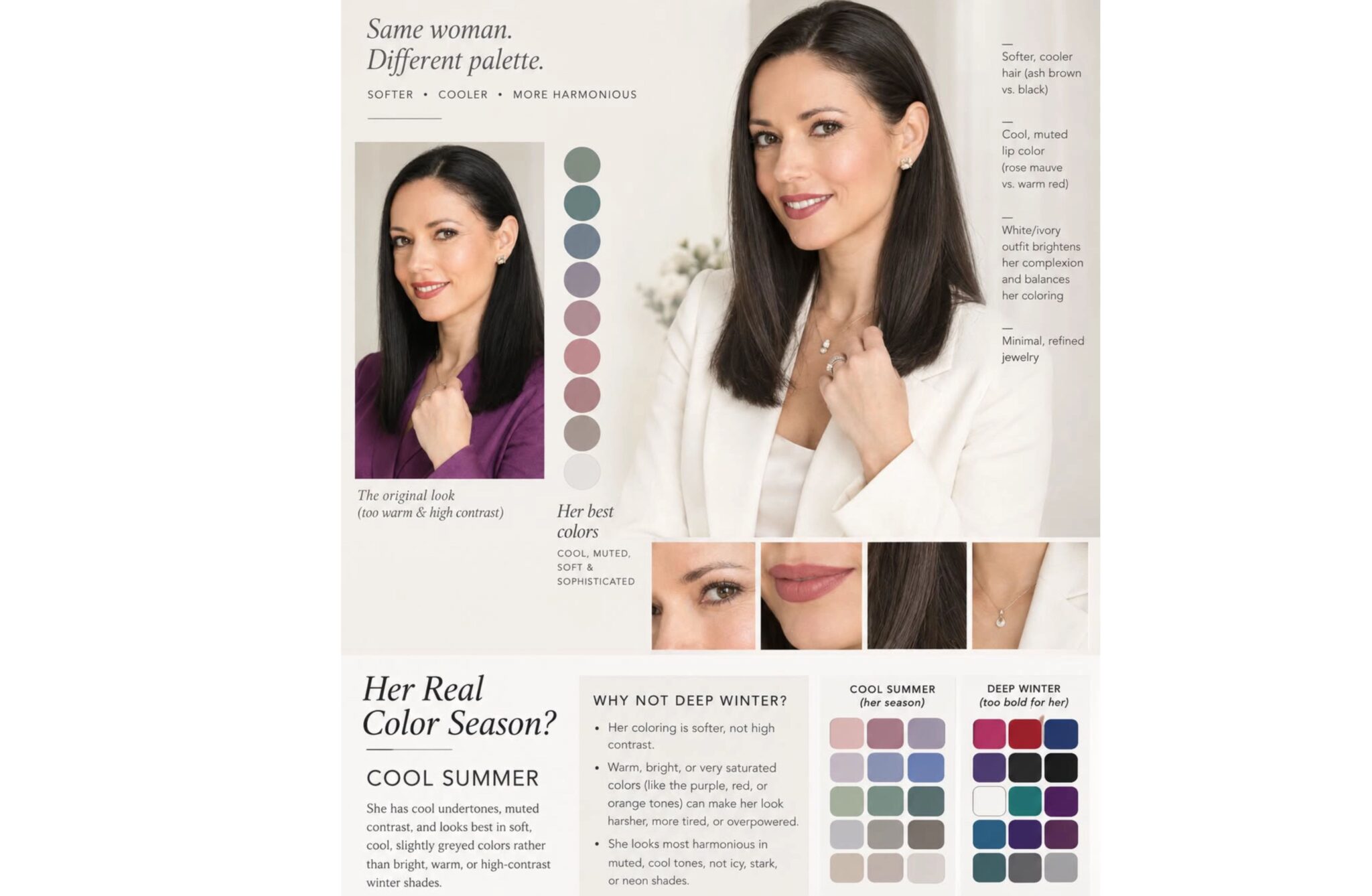
But You Also Analyze People Online From Photos
Correct.
I have been successfully performing professional online color analysis for years.
The difference is that I do not take one photograph, measure the visible colors, and automatically assign a season.
Clients receive very specific photography instructions.
I review multiple photographs.
I compare different color directions through my professional online draping process.
And I interpret what I am seeing.
If something looks inconsistent, I notice it.
If I can see that the hair is colored, I account for it.
If somebody looks tanned, I account for it.
If one photograph is obviously warmer than another, I do not simply average the information and hope for the best.
If I need another photograph, I ask for one.
That is the difference with professional online color analysis.
The photograph gives me information.
It does not make the decision for me.
What Does a Professional Color Analyst See That AI Still Misses?
This is where color analysis becomes much more than comparing numbers.
I always say that color analysis is both technical and artistic.
Of course, I am evaluating undertone, depth, intensity, contrast, and the person’s response to different colors.
But after working with thousands of people, I am also observing nuances that are extremely difficult to reduce to a numerical formula.
I am watching the entire face.
What happens to the skin?
What happens to the eyes?
Does the face suddenly become more defined?
Does pigmentation become more visible?
Do shadows become stronger?
Does the person disappear behind the color?
Does the color make the person look alive?
And there is another part that I think is extremely underestimated:
sense of style and aesthetics.
When I analyze someone, I am already seeing that person in the finished picture.
I can visualize the hair.
The makeup.
The clothing.
The level of contrast.
The color combinations.
The jewelry.
The overall styling.
I can see how this palette is going to translate onto an actual human being.
That sense of aesthetics absolutely influences professional judgment.
AI can calculate.
AI can classify.
AI can generate suggestions.
But a professional stylist uses an experienced human eye and aesthetic judgment to understand how the entire person will come together.
That is a very different process.
Three AI Color Analysis Apps Said Soft Summer. She Was Bright Winter
One of the strongest examples I have seen was a client who flew to see me from Spain.
Before coming to me, she had used three different AI color analysis apps.
All three gave her the same result:
Soft Summer.
Three apps.
Same answer.
Sounds convincing, right?
She was Bright Winter.
These are dramatically different palettes.
Soft Summer is muted and gentle.
Bright Winter needs significantly more intensity, brightness, and contrast.
She came to me because she knew something was wrong.
She kept trying to use her Soft Summer colors and nothing was working.
She looked washed out.
She felt dull.
She could not understand why this color analysis that was supposed to make everything easier was making her feel worse.
Her confidence dropped dramatically, and she told me that this period affected other areas of her life as well, including work.
Then we did her professional analysis.
Bright Winter.
Suddenly, the colors made sense.
Her face came alive.
She could finally see herself.
And even now, she still sends me messages telling me how much that analysis changed her life.
There is something else I find fascinating about this case.
Three different AI tools gave her the same wrong season.
That does not automatically mean those three programs used identical technology.
But it demonstrates something very important:
multiple AI results agreeing with one another does not prove that the result is correct.
If they are interpreting similar visible information through similar seasonal logic, they can arrive at the same conclusion.
And all of them can still be wrong.
Is AI Color Analysis Ever Accurate?
Of course.
Sometimes AI will give exactly the same result that I would.
Sometimes it will get very close.
Sometimes it will be completely wrong.
That is exactly the problem.
There is no consistent answer that says AI color analysis is always wrong.
There is also no reason for me to tell someone to trust an automated result simply because it looks technologically impressive.
If you want to use AI color analysis for fun, absolutely.
Try it.
Compare the results.
Play with it.
But if you are about to change your hair, replace your makeup, rebuild your wardrobe, and start spending serious money based on that result, I would think very carefully.
Because the expensive part is not the AI analysis.
The expensive part is what happens after a wrong analysis.
The Real Cost of a Wrong AI Color Analysis
Imagine being told that you are Soft Summer when you are actually Bright Winter.
Now you start shopping.
You buy muted blue.
Dusty pink.
Soft gray.
Muted makeup.
Maybe you change your hair.
You build an entire wardrobe around that result.
And every time you get dressed, something still feels wrong.
Then people often come to the conclusion:
“Color analysis doesn’t work for me.”
But color analysis was never necessarily the problem.
The analysis was wrong.
And now you have spent hundreds or thousands of dollars trying to force yourself into the wrong palette.
This is exactly why I would never recommend choosing a color analysis method based only on what is fastest or cheapest.
Your season becomes the foundation for many future decisions:
Getting that foundation right matters.
Will AI Replace Professional Color Analysis?
Nobody knows.
And after almost 20 years in technology, I would never confidently predict what AI will or will not be capable of ten years from now.
AI will improve.
Image recognition will improve.
Color correction will improve.
Models will become more sophisticated.
Could AI become an incredible supporting tool for professional color analysis?
Absolutely.
Do I believe it will most likely replace an experienced professional color analyst completely?
No.
Because professional color analysis is not only color measurement.
It is observation.
Interpretation.
Experience.
Comparison.
Aesthetic judgment.
Styling vision.
And understanding a human being as a whole.
Technology can become extraordinarily sophisticated.
But replacing an experienced human eye is a much bigger challenge than matching colors on a screen.
Should You Use AI or Get a Professional Color Analysis?
The choice is yours.
If you want to experiment with AI color analysis, experiment.
But understand what you are getting.
You are receiving an automated interpretation of color information captured from a photograph.
If you are going to use that result to make expensive decisions about your appearance, wardrobe, makeup, and hair, I personally would not take that chance.
A professional color analysis costs more upfront.
A completely wrong wardrobe costs much more.
If you have already tried AI color analysis and something still feels wrong, stop forcing yourself to fit the result.
Your colors should make sense when you wear them.
And if they do not, get your season professionally checked.
Professional 16-Season Color Analysis With Agile Styling
At Agile Styling, I use a professional 16-season color analysis system and years of experience analyzing thousands of clients.
My professional online color analysis uses detailed photography requirements, professional draping, and human interpretation.
The goal is not to place your visible RGB values into the nearest seasonal category.
The goal is to identify the palette that actually creates harmony with you.
Frequently Asked Questions About AI Color Analysis
AI color analysis begins with the digital color information captured in your photograph.
Digital images commonly represent color numerically through RGB values. Depending on the tool, those values may be sampled directly, converted into another color space, or processed through a more complex AI or computer vision model.
The system then interprets characteristics such as skin, eyes, hair, depth, contrast, and undertone and classifies them against seasonal color parameters.
At the digital-image level, color information is commonly represented through RGB values.
An AI system may later convert that information into another color space or process it through a more complex model, but the analysis still begins with numerical color information captured from the photograph.
The biggest limitation is interpretation.
AI can process the visible color information in an image, but professional color analysis requires understanding why those colors appear the way they do and how the person actually responds to different color directions.
Yes.
Lighting, white balance, exposure, camera processing, shadows, and mixed lighting can all change the color information captured in a photograph.
If that photographed color shifts, the information being analyzed shifts too.
Yes.
A tan changes the visible skin color captured by the camera.
If the system uses visible skin color as part of its classification, temporary tanning can influence the information being analyzed.
Potentially, yes.
If an AI system uses visible hair color as one of its inputs, dyed hair can become part of the classification even though it does not represent your natural coloring.
Different AI tools can interpret similar visible information in similar ways.
Several apps agreeing does not automatically validate the result.
The important question is whether that palette actually creates harmony with you.
Sometimes.
AI color analysis can produce the same result as a professional analysis, a similar result, or a completely different result.
If you are making major wardrobe, makeup, or hair decisions based on the result, professional verification gives you a much stronger foundation.
A professional analyst interprets the photographs rather than allowing the photograph itself to determine the result.
A trained analyst can recognize inconsistent lighting, dyed hair, tanning, makeup, unusual feature combinations, and other factors that may distort the visible information.
The analyst can also compare multiple color directions and request additional photographs when necessary.
AI can generate styling recommendations and recognize visual patterns.
Professional styling also involves aesthetic judgment, experience, visual harmony, and seeing how the complete person will look once hair, makeup, clothing, accessories, and color are brought together.
I would not use an AI result alone as the foundation for a major wardrobe transformation.
If the analysis is wrong, you may spend significantly more replacing clothing, makeup, or hair color than you would have spent confirming your season professionally first.
Do not force yourself to make the palette work.
If the recommended colors consistently leave you looking washed out, dull, overly yellow, gray, or disconnected, have your season professionally analyzed.
Book a Professional 16-Season Color Analysis With Agile Styling